

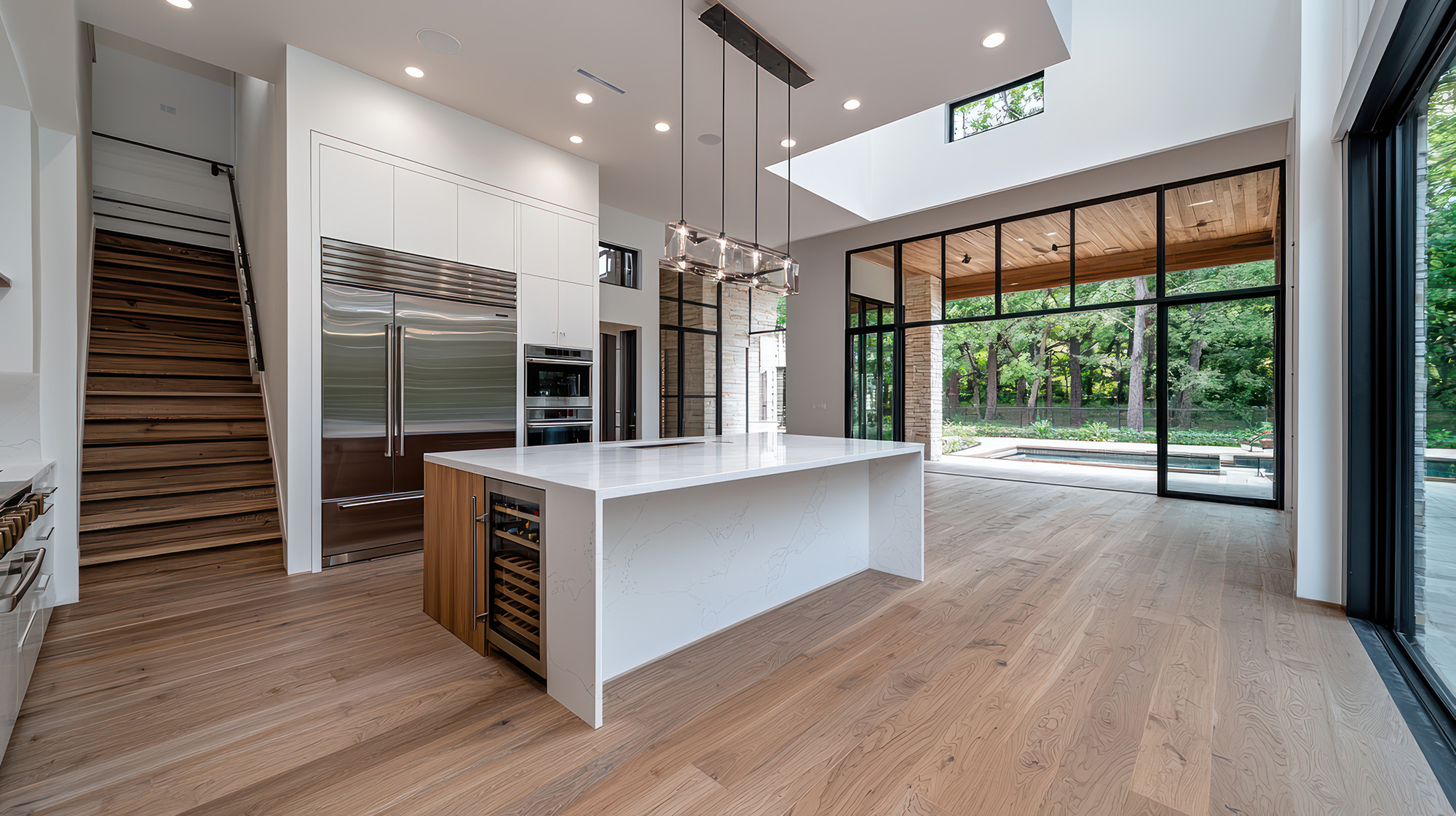
Stairs can almost always be brought much closer to a new hardwood floor, but the usual advice skips the two things that actually decide how close.
Those two things are what your treads are made of and where your new floor is heading in colour over the next few years.
Most guidance on this subject stops at "sand them and use the same stain." That works often enough to sound reasonable and fails often enough to be worth unpacking, because stairs and floors are different products made in different ways, and they respond to the same tin of stain differently.
Your Treads Are Probably Not The Same Wood As Your Floor
Stair treads carry concentrated load over an unsupported span, so they are milled considerably thicker than flooring, often around an inch or more against the three quarter inch that is standard for solid strip flooring. That thickness requirement means treads are manufactured as their own product category rather than cut from flooring stock, and the species available in tread form has always been narrower than the species available in flooring.
The practical result is that a great many houses have red oak treads under a floor that is something else entirely. Red oak dominates tread production because it is strong, widely available and takes a stain predictably. So when a homeowner lays white oak, hickory or maple and then tries to match the staircase, they are frequently not matching two finishes on the same wood. They are trying to make one species read as another, which is a materially harder problem and worth knowing about before expectations get set.
Match The Floor It Will Become Not The Floor It Is Today
Wood keeps changing colour after it is installed. Light and air drive a slow shift in tone that is well understood in the trade and almost never mentioned to homeowners planning a staircase match. American cherry deepens dramatically. White oak with an oil finish warms considerably. Maple yellows. The floor delivered to your house in autumn is not the floor you will be looking at in three years.
Your existing staircase has already finished most of that journey. It has spent decades under daylight and has settled into its mature colour. If a finisher matches stain to a brand new floor on day one, the two surfaces drift apart as the floor ambers and the stairs stay put. The better approach is to ask what the new floor will look like once it has settled, and aim the stair colour slightly ahead of where the floor starts. Suppliers and manufacturers can usually speak to how a given species and finish behaves over time, and that conversation is worth having before any stain is mixed.
Why The Same Stain Lands Differently On Stairs
A floor gets sanded by a large drum or belt machine that cuts evenly across a wide area. A staircase gets sanded by hand and with small edging tools, working into corners, around nosings and against risers. Those methods leave the wood at different surface textures even when the crew finishes on the same grit, and surface texture governs how deeply stain penetrates.
Finer sanding closes the wood and reduces absorption, so an over sanded tread takes less pigment and finishes lighter than the floor beside it. Coarser sanding opens the wood and pulls more colour. Add in the density difference between a thick tread and a thinner floor board and the same stain can land noticeably apart on the two surfaces. This is exactly why a test panel matters. Testing on an offcut or an inconspicuous bottom tread, finished the same way the staircase will actually be finished, tells you far more than a stain chart ever will.
The Riser Trick That Removes Most Of The Problem
Painting risers in a clean white or off white is not purely a style decision. It interrupts the eye between the floor and the tread, so the two wood surfaces are never read side by side in a continuous sweep. A tread that would look slightly off against the floor in an all wood staircase reads as entirely deliberate once a painted riser sits between them.
Nosing profile deserves the same attention. At the top step, the floor meets the stair at the one point where both surfaces are visible in the same glance and at the same angle, which is where a mismatch shows most. Getting a nosing that suits the new floor, and treating the top step as the piece that has to be right, buys a lot of forgiveness further down the flight.
Working This Out Before The Floor Is Ordered
The realistic goal with a staircase is a confident, intentional match rather than an invisible one, and almost everything that determines which you get happens before anything is ordered. Knowing your tread species, understanding how your chosen floor will age and planning a test panel turns a gamble into a decision.
L.A.F Floors & Interiors works through stair and floor coordination with homeowners across Worcester, Shrewsbury, Westborough, Southborough, Northborough, Grafton, and Millbury, MA, including which collections offer coordinating treads and nosing and how a given species is likely to settle in over time.
Visit our showroom in Shrewsbury, MA, one of Shrewsbury, MA, to look at species and finishes with your existing staircase in mind. We proudly serve homeowners across Worcester, Shrewsbury, Westborough, Southborough, Northborough, Grafton, and Millbury, MA. Contact us to plan your stairs and floors as one project, or browse our hardwood flooring collection to compare species and finishes.

